
Data Visualisation – Making the Invisible, Visible
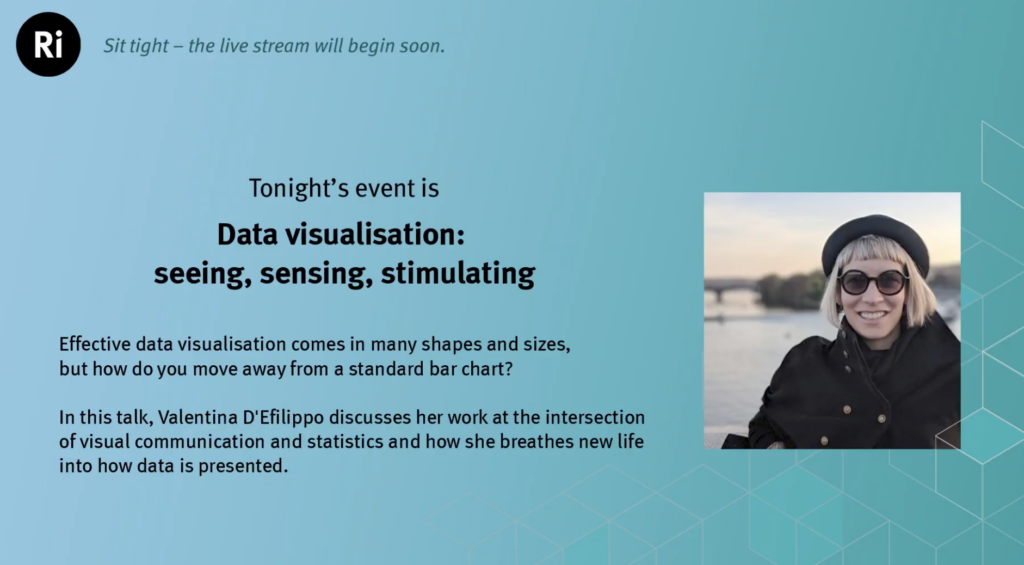
I attended a fantastic Royal Institution event today – Data visualisation: seeing, sensing, stimulating from Valentina D’Efilippo – @defilippovale
It started with a historical context and problem solving in the 1800’s. John Snow mapped the outbreak of cholera in Soho and noticed the proximity of high infection rates to certain street water pumps. Concentrations around Broad Street (todays Broadwick Street) were observed as a source of the disease which was confirmed when the pump handle was removed. Also note worthy were the lack of cases at the nearby brewery proving the health benefits of beer? A great early use of data science and visualisation.
Giving more modern examples, a plethora of Covid 19 data visualisation charts were shown and the importance of these in telling the story of what is happening. The “flatten the curve” charts have been a really good visualisation and story telling vehicle with great impactful on policy and the public response.
Overall the importance of both hearts and minds was emphasised by the emphasis on both the Science and Art. The science comprising of data and statistics. The art more concerned with graphic design and visual story telling.
A few other noteworthy things to follow up in my notes:
William Playfair – The inventor of modern pie charts / graphing / charting
Global warming colour spectrum – a colour plot telling the compelling story of climate change
Data Design Principles
- Data – as creative material
- Design – as a tool to aid understanding
3 steps to an impactful visualisation:
- See – make data visible
- Sense – the implications should be clear
- Stimulate – the data should drive action
The presenter has produce a book: Infographic History of the World – book by the author
She gave three examples
Example 1
Which was the most significant war – 133 wars 95 M deaths
She used inspiration from science, art, nature
Looking at Poppy and its significance – using flower size, stem length and height to represent the data
Example 2
What would music look like through data visualisation?
Using David Bowie for inspiration and his song Space Oddity which in turn was influenced by the film 2001 a Space Odessy and by the 1960’s Apollo Moon missions. Some of the techniques used included:
- Zoom into the grooves!
- Major Tom and Ground Control characters represented and their distance apart
- Visual form to the music itself
Overall the data was the vehicle to explain human experiences.
Example 3
Social Media force for change – MeToomentum.com from the impactful movement from the Alyssa Milano tweet @Alyssa_Milano
The visualisation used the Dandelion metaphor with the following attirbutes
- Spreading – geography
- Rooting – what themes / what / where / who
- Trending – popularity – loudest voices / re-tweets / followers
A powerful way to show – creators have the power to shape the way others understand the world!
A great summary at the end – data visualisation provides a snapshot of a complex world
@defilippovale
Question and answers session:
Dataforc
hange – hear the blind spot – google search this – bring data to life through sound
First thing to do when creating a visualisation:
Who are we talking to and what are we trying to do?
Tools
Visualisation book – Excel / Adobe Illustrator
For the websites and other projects::
E3 – javascript library and SVG’s
Tableau
Datagraph
Dataillustrator Beta
Rawgraph.io
Also interesting
Mapping disease: John Snow and Cholera: